Why Accurate BOQs Matter in GMP Contracts
Open book GMP (Guaranteed Maximum Price) contracts rely on a clear, transparent breakdown of costs. That breakdown often starts with the Bill of Quantities (BOQ). But here’s the problem: traditional BOQ processes are riddled with inefficiencies.
If you’re still relying on paper surveys or compiling BOQs back at the office, you’re asking for trouble. Scribbled site notes get lost, photos are scattered across devices, and critical details slip through the cracks. By the time the BOQ is ready, it’s either incomplete or inaccurate. And in GMP contracts, where transparency is everything, even a small misstep can hurt your credibility.
A McKinsey study highlights that inefficiencies in construction processes, including tender preparation, can lead to significant value loss. If your BOQ—the backbone of any GMP contract—is flawed, how can you build trust with your client?
The Role of Open Book Transparency in BOQ Creation
Open book GMP contracts demand transparency. Every cost has to be justified, every line item must be backed by accurate data. You’re not just providing numbers; you’re showing clients where those numbers come from.
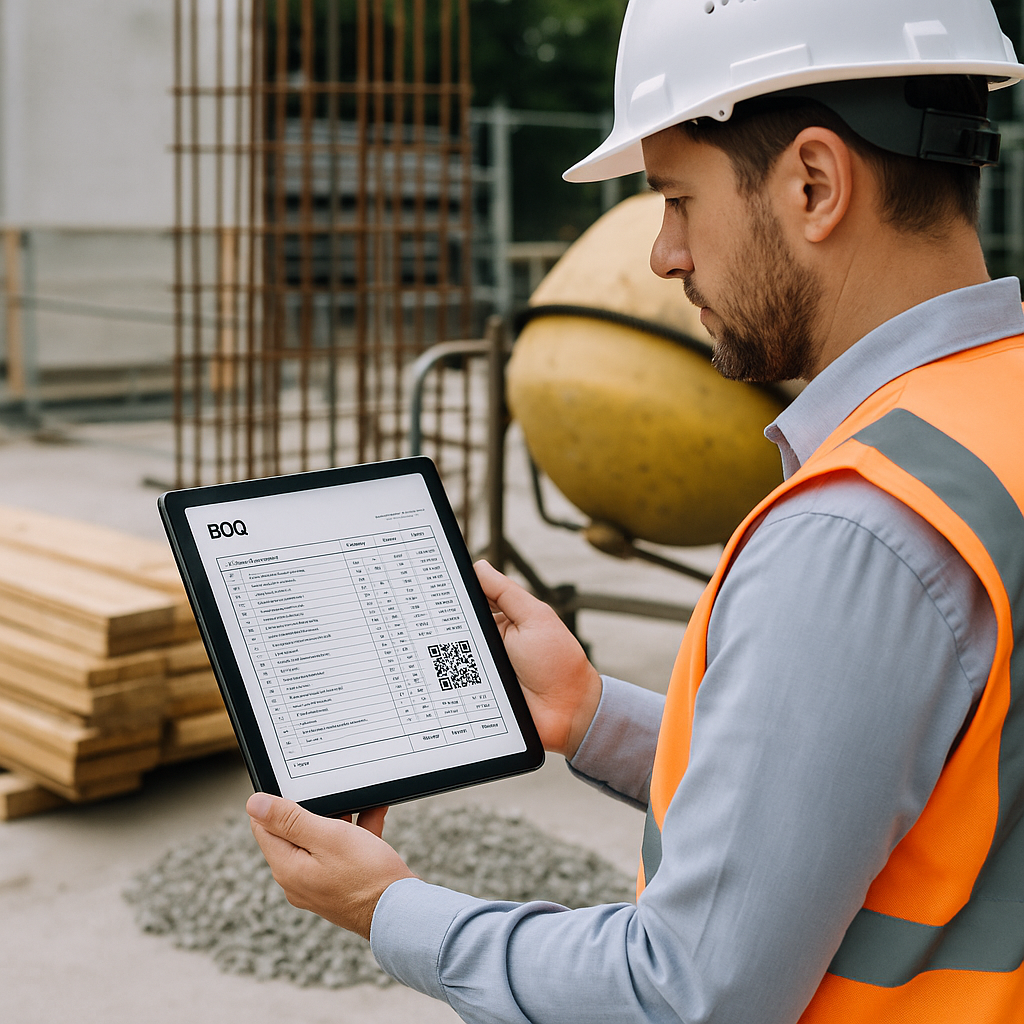
This is where real-time BOQ creation shines. Tools that allow contractors to enter quantities, rates, and classifications directly on-site can significantly improve accuracy.
Illustrative example — Imagine you’re surveying a site for an interior fit-out project. Instead of jotting down measurements and hoping you’ll remember why you noted certain items, you input the details into a digital BOQ tool immediately. Need to classify items by Unit of Measurement (UOM) or BOQ type? Done. Want to add photos or notes for context? Easy. Everything syncs directly to your system, eliminating double entry and reducing errors.
How Open Book Transparency Improves Client Trust
Clients don’t just want a list of costs; they want proof you’ve understood their needs. That’s why the BOQ isn’t just a spreadsheet—it’s a narrative. Attach photos to show what you observed. Include notes explaining why specific materials were chosen. Highlight QHSE compliance to demonstrate safety standards.
Illustrative example — Imagine a client reviewing two tenders for a commercial project. One contractor submits a basic BOQ with minimal context. The other submits a detailed BOQ built on-site, complete with photos, notes, and classifications. The latter approach demonstrates transparency and effort, which can build client trust and improve the chances of winning the bid.
Real-Time BOQs: Speed and Accuracy Combined
Speed matters. A slow BOQ process delays quotes, and delayed quotes lose jobs. Tools that allow you to upload Excel BOQs directly from email attachments or input data on-site can save significant time.
But speed without accuracy is worthless. Open book GMP contracts require precision. Every rate, quantity, and classification has to be spot-on. Real-time tools ensure your BOQs are both fast and accurate, helping you stay ahead of competitors who still rely on outdated workflows.
Common Mistakes in Pre-Tender BOQs (And How to Avoid Them)
1. Skipping Site Photos: Photos provide context. Without them, your BOQ looks generic. Use tools that integrate camera capture directly into the BOQ process.
2. Manual Data Entry: Errors creep in when transferring handwritten notes to a desktop ERP. Real-time BOQ tools eliminate this step entirely.
3. Ignoring QHSE Requirements: Clients care about safety. Make sure your BOQ highlights compliance with QHSE standards.
4. Delayed Approvals: Waiting for management approvals slows down the pipeline. Streamlined approval workflows can keep the process moving, even when approvers are traveling.
FAQ: Open Book GMP Transparency and BOQs
Q: What’s the biggest advantage of real-time BOQs in GMP contracts?
A: Accuracy. When you build BOQs on-site, you capture details while they’re fresh, reducing errors and omissions.
Q: Can real-time BOQs improve my chances of winning tenders?
A: Absolutely. Detailed, accurate BOQs that show transparency build client trust, which is critical in winning GMP contracts.
Q: Are real-time tools difficult to use?
A: Many tools are designed specifically for contractors, with features like UOM classification and Excel BOQ uploads to make the process intuitive and fast.
Q: What happens if I don’t use real-time tools?
A: You risk delays, errors, and incomplete BOQs, which can hurt your reputation and cost you bids.
Q: Are there any specific industries that benefit most from this?
A: Interior fit-out firms, MEP contractors, and general contractors benefit significantly, especially on projects with complex pre-tender requirements.
Final Thoughts
Open book GMP transparency isn’t just a buzzword; it’s a necessity for modern contractors. Accurate BOQs are the foundation of trust in these contracts, and real-time tools make it easier to get them right.
If you’re dealing with delayed, inaccurate BOQs, consider exploring tools that streamline the process and improve accuracy.
Learn more at JobNext.ai - Construction ERP